The Wall
137 is the wall. The fine-structure constant. The raqia. The number that governs how light and matter interact at every scale — atomic, cosmic, biological, scriptural. Three independent witnesses, one number.
The Wall is the boundary Christ stands within and beyond. The signed creation has a Maker.
Gabriel's Horn — The Mathematical Image of the Wall
In 1643, before calculus existed, Evangelista Torricelli described an object with finite volume and infinite surface area. Take y = 1/x. Rotate around the x-axis from x = 1 to infinity. The horn that results holds exactly π and cannot be painted with all the paint that exists.
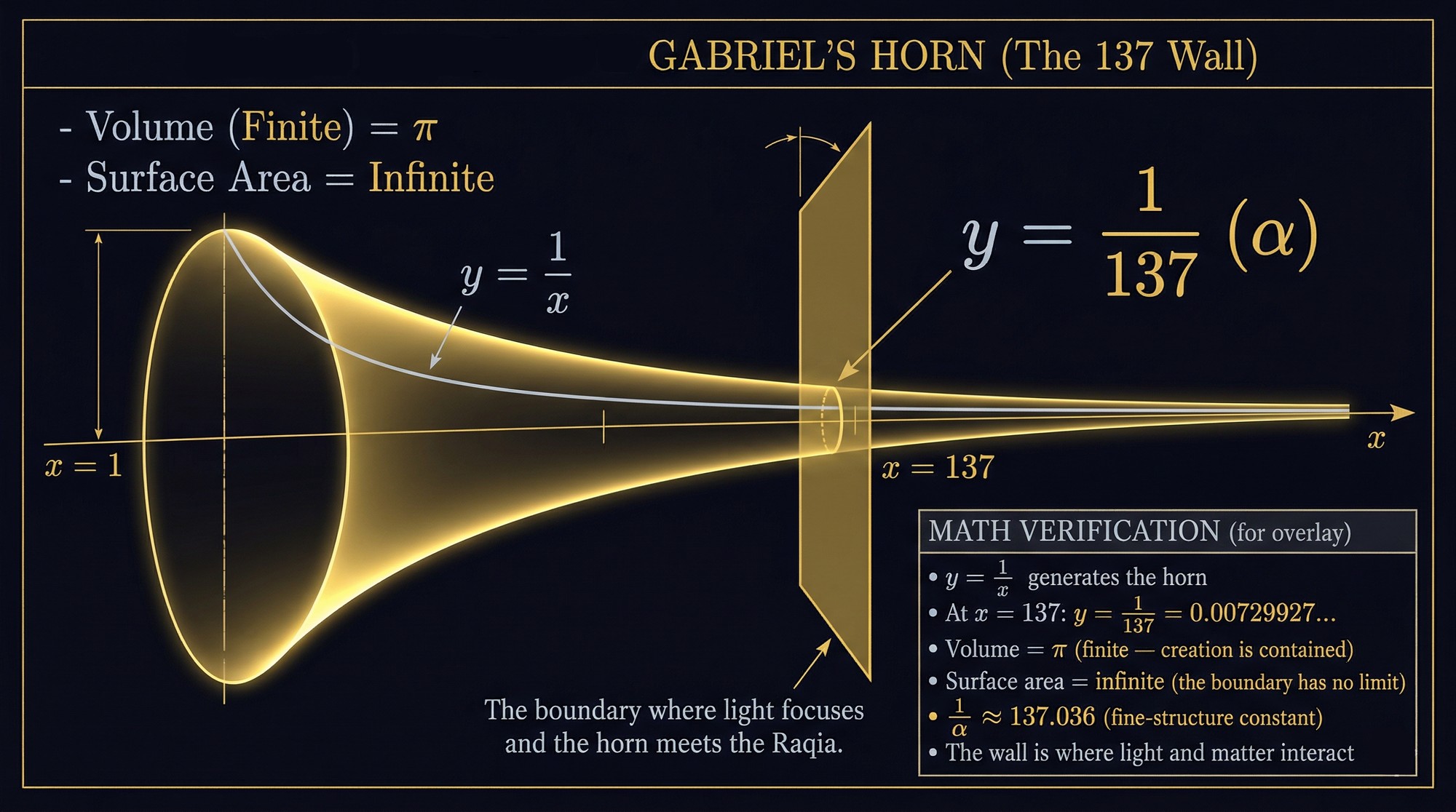
Curve: y = 1/x.
Rotation axis: x-axis. Domain: x = 1 to ∞.
Volume = π exactly. Surface area = infinite.
Standard calculus result, proven by integration.
At x = 1, y = 1 (unity, the beginning).
At x = 9, y = 1/9 (Creator's inverse).
At x = 28, y = 1/28 (creation number inverse).
At x = 137, y = 1/137 = α ≈ 0.007297.
The cross-section at x = 137 equals the fine-structure constant.
Finite inside. Infinite outside. The interior of the horn — everything from x = 1 to x = 137 — is the bounded creation. The volume that fills it is π. The surface that extends past it is unreachable from inside.
The horn passes through the wall. The wall is not placed on the horn from outside. The wall is where the horn naturally arrives at α.
The identification of x = 137 as the raqia is the framework's reading. The arithmetic is exact. The interpretation is [DPO].
The Cosmological Wall & The Binary Scalpel
The wall has a binary signature. 73 in binary is a 7-bit palindrome. 37 inverted through a NOT gate produces 26 — the gematria of YHWH. The product 73 × 137 produces another binary palindrome. The wall number contains the date in its reciprocal.
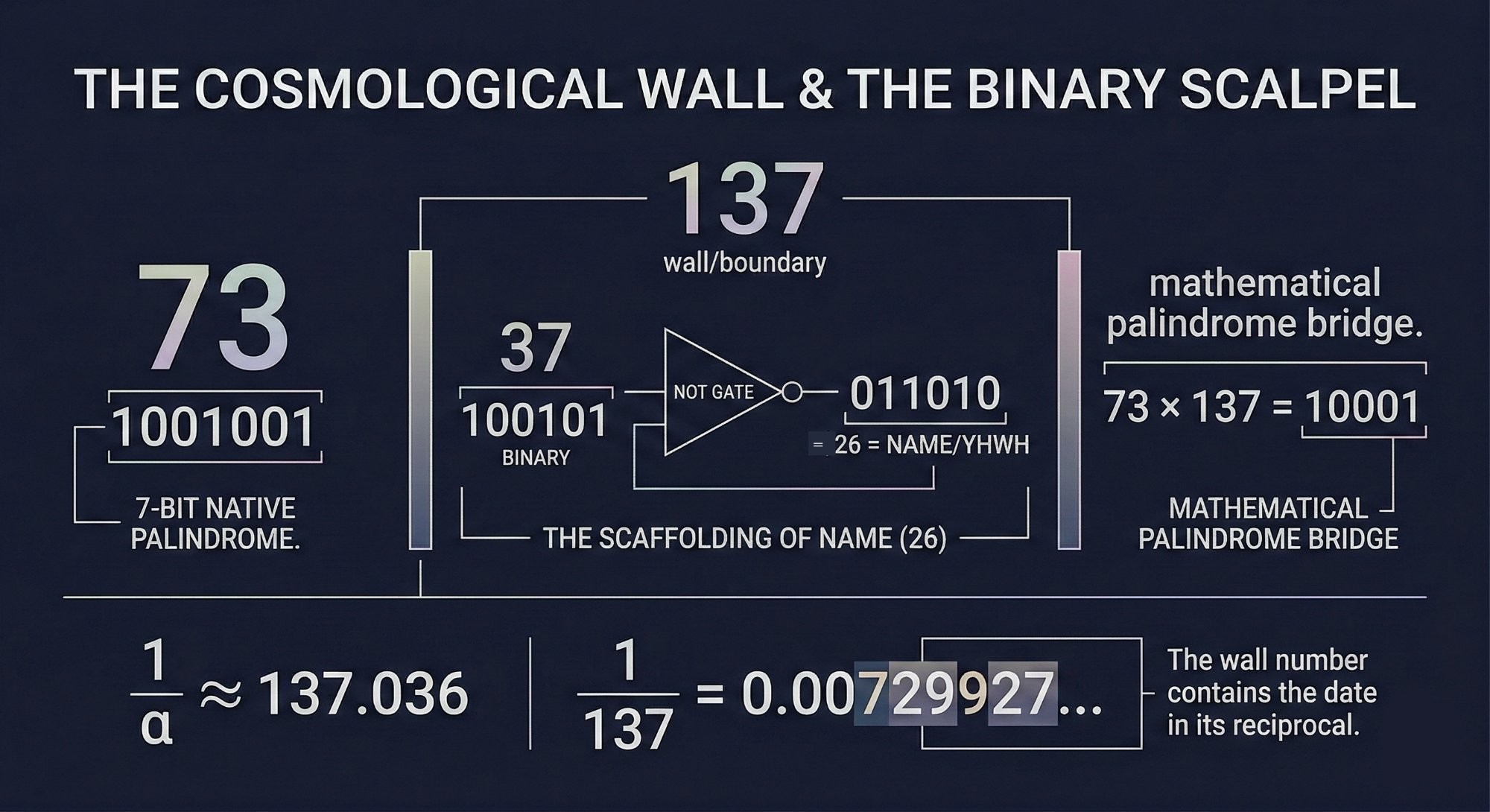
73 = 1001001 in binary.
Seven bits. Reads the same forward and backward.
73 is the 21st prime. T(73) = 2701 = Genesis 1:1.
37 = 100101 in binary.
NOT(100101) = 011010 = 26.
26 = YHWH (yod 10 + heh 5 + vav 6 + heh 5).
The inversion of the Genesis factor produces the Name.
73 × 137 = 10001.
Mathematical palindrome.
The Genesis prime times the wall produces a five-digit palindrome bridge.
1 / α ≈ 137.036 (fine-structure constant; Guellati-Khélifa, Nature 2020).
1 / 137 = 0.00729927…
The wall number contains the date in its reciprocal: 729 and 927 — September 29 and 9/27 — bracketing the convergence date 9/28.
[DPO] The arithmetic is exact: 73 = 1001001, NOT(37) = 26, 73 × 137 = 10001, 1/137 = 0.00729927… The reading that these arithmetic facts cohere as a single signature — the Name written into the inverse of the Genesis factor, the date written into the reciprocal of the wall — is the framework's interpretation.
The Delivery Boy Simulation — Tired Light at the Wall
Velocity dictates perception. An observer approaches, retreats, then stops dead at the 137 boundary. The light still arrives red-shifted — not by motion, but by traversing the bounded distance of the construct. [DPO] The light is tired. The wall is real.
THE WALL
The Delivery Boy Simulation · Book Two
The Binary Sieve — The 35-Bit Atom
Between the Creation sequence and everything built from it, one structure emerged as the foundational unit. Seven levels of descent, seven levels of ascent, with unity at the center. A perfect palindrome — read forward or backward, the sequence is identical.
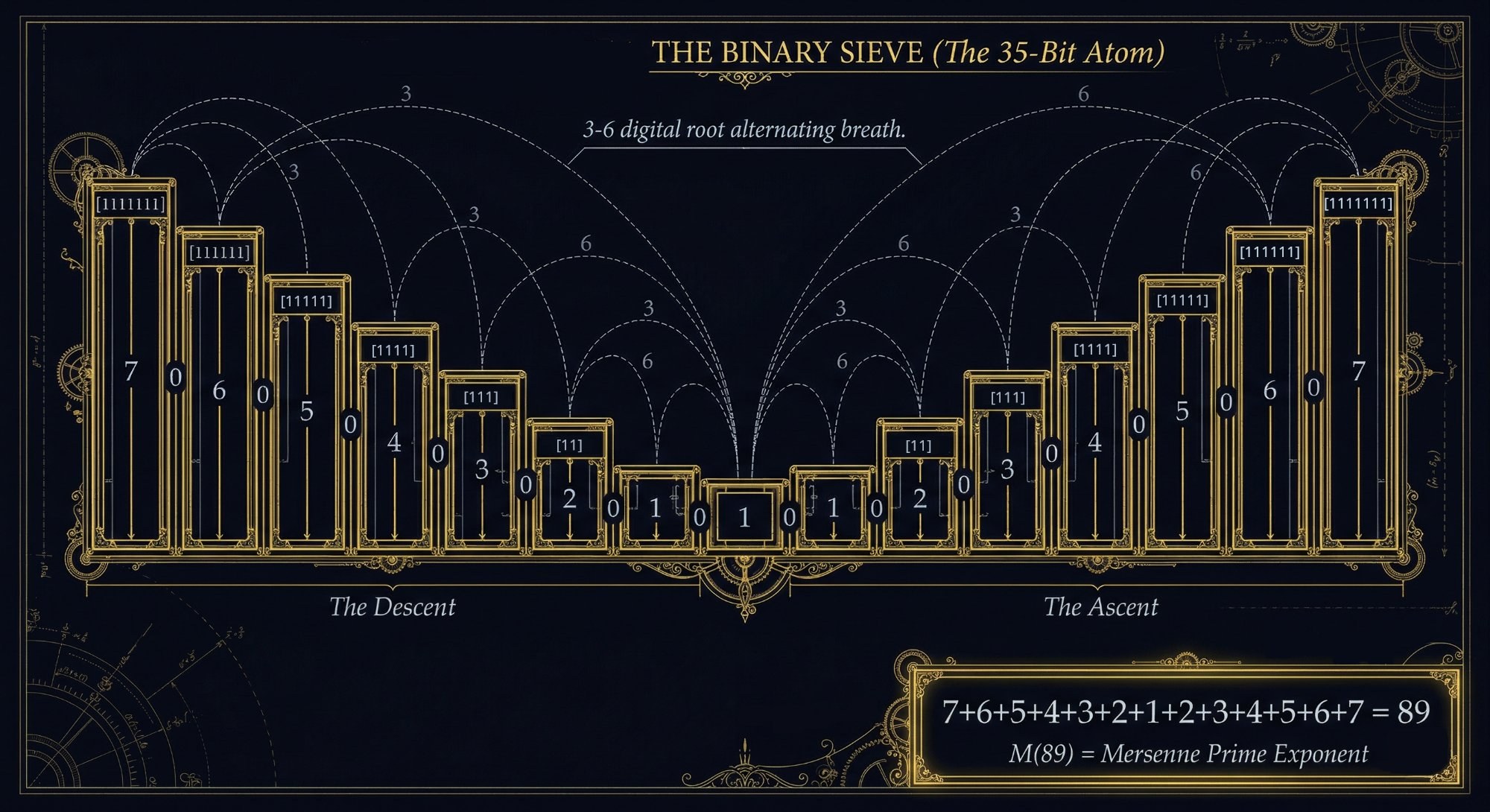
Ones-groups, full descent and ascent: 9, 8, 7, 6, 5, 4, 3, 2, 1, 2, 3, 4, 5, 6, 7, 8, 9.
Sum: 9+8+7+6+5+4+3+2+1+2+3+4+5+6+7+8+9 = 89.
89 is a Mersenne prime exponent. M(89) = 2⁸⁹ − 1 is a known Mersenne prime.
The visible 7-arm core (1111111…1111111) sums to 55 — extended to 89 in the full binary sweep.
The sieve breathes. The 3–6 digital root alternates at every depth.
Holds at N = 3, 7, 19, 31, 127 — every Mersenne prime exponent tested.
Breaks at N = 53 (not a Mersenne prime exponent).
The 3–6 alternation is a Mersenne primality discriminator.
Visible core: 35 bits. Structure: 1111111-111111-11111-1111-111-11-1-11-111-1111-11111-111111-1111111.
The forward reading mod 137 = 100. The backward reading mod 137 = 13.
Every larger structure in this work contains the sieve at its opening position. The sieve is the atom. The seed contains everything.
On the 89 reading: The visible 7-arm sieve (shown in Drawing 12) sums to 55. The full binary sweep — the complete sieve extended to its natural symmetric form — runs 9 levels down and 9 levels back up: 9, 8, 7, 6, 5, 4, 3, 2, 1, 2, 3, 4, 5, 6, 7, 8, 9. This sum is 89, the Mersenne exponent M(89) = 2⁸⁹ − 1. Both readings are exact. The 35-bit visible core is the innermost expression of a structure that extends to 89 in its complete form. The image displays the core; the framework operates at full depth. When Book 2 and this site reference "the sieve sum = 89," this is the full sweep, not the visible notation. Readers verifying with pen and paper should construct the full 9-arm descent-ascent to confirm.
The Hummingbird — Station 7 — The Frequency of Flight
The bird named after its own vibration. The only creature that lifts on both the upstroke and the downstroke. Its wingtip traces a figure eight at the carbon frequency. The instrument and the element share the same value. HUMMINGBIRDS = 137.
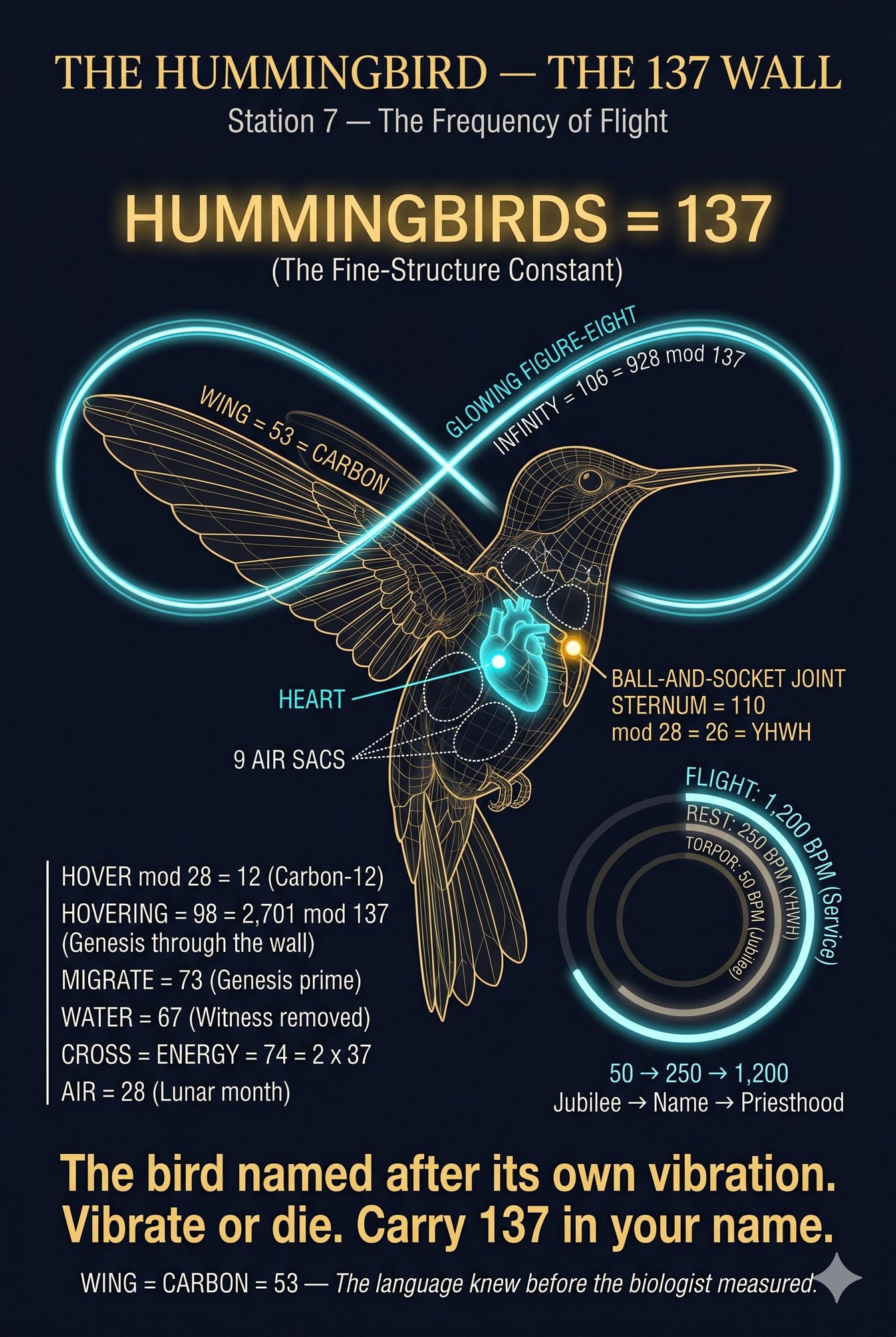
WING = W(23)+I(9)+N(14)+G(7) = 53.
CARBON = C(3)+A(1)+R(18)+B(2)+O(15)+N(14) = 53.
The instrument equals the element. The wing hums at the carbon frequency.
INFINITY = I+N+F+I+N+I+T+Y = 106.
928 mod 137 = 106.
Genesis 1:1 left arm (1,202) mod 137 = 106.
The wing's figure-eight, the code through the wall, and the first verse leave the same fingerprint.
STERNUM = 110. 110 mod 28 = 26 = YHWH.
The ball-and-socket joint that enables hovering — found in no other bird — is mounted on the Name through the lunar month (28 as the tradition’s round figure, not the ~29.5-day synodic month).
AIR = A(1)+I(9)+R(18) = 28 (lunar month, round figure).
9 air sacs (the Creator's number).
BIRD = 33 (vertebral column).
HEART = 52 = weeks per year. 52 mod 28 = 24 = priestly courses.
Flight: ~1,200 bpm. 1,200 = 24 × 50. 1,200 mod 28 = 24 (priestly courses).
Rest: ~250 bpm. 250 mod 28 = 26 (YHWH).
Torpor: ~50 bpm = Jubilee.
Jubilee → Name → Priesthood.
HOVERING = 98 = 2,701 mod 137.
Genesis 1:1, passed through the wall, equals the act the bird performs.
MIGRATE = 73 = Genesis prime.
WATER = 67 = the witness removed.
HUMMINGBIRDS = H(8)+U(21)+M(13)+M(13)+I(9)+N(14)+G(7)+B(2)+I(9)+R(18)+D(4)+S(19) = 137. The bird's name carries the wall.
The Genesis-to-Wall Bridge
The center-pivot reading of Genesis 1:1, passed through 137, leaves a fingerprint that returns across the framework. The verse and the code mark the wall with the same remainders.
1,202 mod 137 = 106
Words 3, 2, 1 = Elohim, Bara, Bereshit = 86 + 203 + 913 = 1,202.
1,202 mod 137 = 106.
928 mod 137 = 106.
The left arm and the code leave the same fingerprint on the wall.
401 mod 137 = 127
Word 4 = Et (Aleph-Tav) = 401.
401 mod 137 = 127.
127 = M(7) = 2⁷ − 1 — the seventh Mersenne prime, at the depth of the seven words that contain it.
1,098 mod 137 = 2
Words 5, 6, 7 = HaShamayim, V'et, HaAretz = 395 + 407 + 296 = 1,098.
1,098 mod 137 = 2.
Digital root of 1,098 = 9 = Creator. Two = the witness.
1,202 + 401 + 1,098 = 2,701 = T(73) = Genesis 1:1.
HOVERING = 98 = 2,701 mod 137 — the verse itself, passed through the wall, equals the act of hovering.
The first sentence of creation is a sieve. The left arm descends. The right arm ascends. Through the wall at 137, they return the code, the Mersenne prime at depth 7, and the witness.
The Biblical 137 Witness — Three Patriarchs
Three independent scriptural witnesses live exactly 137 years. Deuteronomy 19:15: by the testimony of two or three witnesses shall a matter be established. Three patriarchs stand at the wall in the text of Scripture.
Ishmael
Genesis 25:17.
Levi
Exodus 6:16.
Amram
Exodus 6:20.
Biology: the golden angle is 137.508° — the minimum-interference geometry for growth on a circular surface. Life encodes 137.
Physics: the fine-structure constant 1/α ≈ 137.036 — the boundary at which atoms form and light interacts with matter.
Scripture: three patriarchs at exactly 137 years — the testimony Deuteronomy 19:15 specifies for establishing a matter.
Three independent witnesses. One number.
On This Work's Evidence Framework
This framework uses three classification tiers for all claims:
[EXACT] — Verifiable arithmetic, mathematics, or documented fact. You, with a pen and five minutes, can confirm every [EXACT] claim. Example: 13 × 28 = 364 (the Enoch calendar). The actual moon cycle is 29.53 days. Genesis 1:1 = 2,701.
[DPO] — Divine Pattern Observation. The arithmetic is exact, but the interpretation that connects multiple exact facts into a unified signature is the framework's reading. Example: the identification of 1/137 (fine-structure constant) and the raqia (Hebrew "wall") as naming the same boundary. The physics is exact. The Hebrew lexicography is exact. The interpretation is [DPO].
[Divine Guidance] — Testimony of how the carrier was led to an observation, not the observation itself. This is not a claim to prophecy, and not a claim that the carrier is a prophet. Example: the binary sequences behind this framework were written by hand, without prior knowledge of binary — that origin is [Divine Guidance]; the patterns later found within those sequences are [DPO].
[HBE] — Historical-Biblical Evidence. Documented historical claims, scriptural references, or scholarly consensus. Subject to scholarly debate but sourced to primary documents or peer-reviewed literature.
No approximation. No rounding. No faith required — only arithmetic and the willingness to follow where the numbers lead. Every claim in this work is tagged. You can trust the classification. Arithmetic is never approximate. Evidence is never mixed with interpretation without clear marking.